
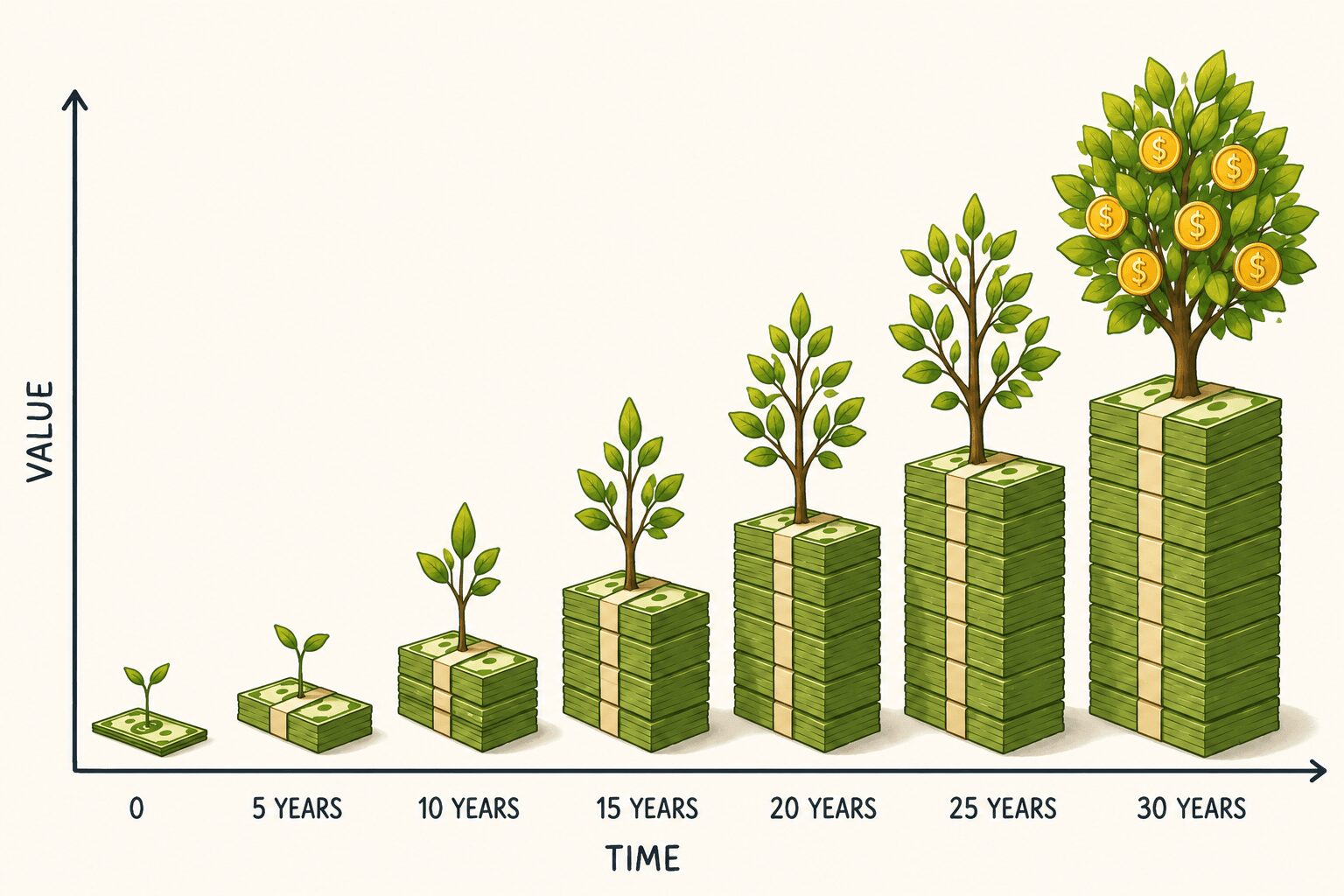
ESPP Explained Simply: Why You Shouldn’t Miss Out
I want to tell you about the work benefit I ignored for years because one coworker told me it was “too complicated.” She meant well. She probably had no idea how it worked either, and honestly, we were just two people who didn’t know, leading each other nowhere. But that conversation cost me thousands of dollars, and I don’t want the same thing to happen to you.
So here it is: ESPP explained simply, from someone who learned the hard way.
What Even Is an ESPP?
ESPP stands for Employee Stock Purchase Plan. And yes, that sounds very finance-y and intimidating. But here’s the simple version:
Your company lets you buy their stock at a discount — usually 15% off — using a small portion of your paycheck.
That’s it. That’s the core of it.
You’re not day trading. You’re not picking stocks. You’re buying something for less than it’s worth and pocketing the difference. Think of it like getting a 15% off coupon on something you can immediately return for full price.
How I Missed It for Years (And How I Finally Found Out)
When I joined my first company that offered an ESPP, I asked a coworker about it. She tried to explain, got a little tangled up, and eventually just said, “It’s too complicated. It’s not really worth it.”
I believed her. I moved on. I left money on the table for that entire time at that company.
Then years later, at a different company, I happened to be going to lunch with some coworkers and overheard them talking about what they were going to do with their ESPP proceeds after the next sale period. I had been at that company for a while at that point and had never once enrolled.
I stopped and asked: “Wait, what are you guys talking about?”
They explained it to me right there. And I was floored.
I had been passing up free money, consistently, for years. Not because I couldn’t afford to contribute. Not because I wasn’t eligible. Just because I never asked the right person.
Don’t be me. Ask the right person. Or just keep reading, because I’m going to give you ESPP explained simply right now.
How It Actually Works
Here’s the step-by-step:
Step 1: You enroll and choose your contribution amount. Most plans let you contribute anywhere from 1% to 15% of your paycheck, up to an IRS limit of $25,000 per year.
Step 2: Deductions come out of each paycheck automatically. You don’t have to do anything. The money gets set aside during what’s called the “offering period” — typically 6 months.
Step 3: On the purchase date, your company buys stock at a discount. At the end of the offering period, your saved contributions are used to buy company shares at a discounted price, usually 15% off.
Step 4: You decide what to do with the shares. You can sell right away and pocket the gain, or you can hold onto the shares if you want to stay invested.
That’s the whole thing. ESPP explained simply is really just: save a little from each paycheck, get stock at a discount, decide what to do with it.
The Numbers (Because Yes, They Matter)
Let’s make it real with an example.
Basic scenario: 15% discount
- Stock is trading at $100/share
- Your discounted purchase price: $85/share
- You contributed $25,000 over the offering period
- You buy approximately 294 shares at $85
- You sell immediately at $100
294 shares x $100 = $29,400 Profit: $4,400 on $25,000 invested
That’s an instant 17.6% return. Not over a year. Right away.

The Lookback Feature: When It Gets Even Better
Some companies sweeten the deal even more with something called a lookback provision. This means the company uses whichever stock price was lower — the price at the beginning OR the end of the offering period — to calculate your discount.
So if the stock went up during those 6 months, you still get the lower starting price as your base.
Lookback example:
- Stock price at start of period (Jan 1): $90
- Stock price at end of period (Jun 30): $100
- Company uses $90 (the lower price)
- 15% discount applied: $90 x 85% = $76.50 per share
- You contribute $25,000, buy approximately 326 shares
- Sell at $100
326 shares x $100 = $32,600 Profit: $7,600 — that’s $3,200 more than without the lookback
Check if your company offers this. It’s a big deal.
What About Taxes?
Yes, there are taxes. But the short version is: you’ll still come out ahead.
When you sell right away, the discount you received is taxed as ordinary income, the same way your regular paycheck is taxed.
Quick example:
- Stock is worth $100, you paid $85 — that’s $15 per share in taxable income
- You bought 100 shares, so $1,500 in ordinary income
- In the 22% federal tax bracket: about $330 in federal tax
- Add state tax (varies by state), and you’re maybe paying $400-$500 total on that $1,500 gain
You still walk away with over $1,000 in your pocket from that example alone. ESPP explained simply means understanding that even after taxes, this is a strong, predictable return most people can’t find anywhere else.
Pro tip: set aside a portion of your proceeds for tax time so you’re not caught off guard.
What I Did With That Money
Once I finally enrolled and sold my first round of ESPP shares, I had a meaningful chunk of money sitting there that I hadn’t budgeted around. It was real profit from something I had been ignoring.
That’s the money I used to fund my first rental property.
I know, that sounds like a big leap. But when you’re consistently selling every offering period and setting that money aside with intention, it adds up faster than you’d think. I did it a few more times after that for additional properties. (I live in a high cost of living area, so the rentals are out of state — more on that in another post — but the point is the ESPP proceeds gave me a starting point I wouldn’t have had otherwise.)
I’m not saying your ESPP will buy you real estate. But it could fund a Roth IRA contribution, knock out a high-interest debt, or start an emergency fund. It’s real money that most people are just leaving on the table.
Should You Sell Right Away or Hold?
This is where people get in their heads. And I’ve been on both sides.
Selling immediately is the low-risk move. You lock in your discount profit, you don’t have to watch the stock, and you walk away with a predictable gain. This is what most financial people recommend for most people, and honestly, it’s what I do now.
Holding can work out if the stock goes up. You’d also potentially qualify for long-term capital gains tax treatment, which is a lower tax rate than ordinary income. That’s a real benefit if you’re patient and the stock cooperates.
But here’s the thing: holding also means you’re exposed to risk. If you work at a company and also hold a lot of that company’s stock, you’re doubling down. If things go sideways at work, the stock often drops right when you can least afford it. That’s a real scenario worth thinking through.
The general wisdom is: take the guaranteed profit. You can always put those proceeds into other investments if you want market exposure.
You Don’t Have to Go All In
One of the biggest myths about ESPP is that it’s only worth doing if you max it out. Not true.
Even contributing 2-3% of your paycheck gets you in the game. You start building the habit, you see a real return, and you can increase your contribution when you’re ready.
And here’s my favorite part of this whole story: I worked in corporate finance and had no clue ESPP existed until years into my career. So if you’re sitting there thinking this is for finance people or investment-savvy types, it is truly not. It is for everyone who gets a paycheck from a company that offers it.
ESPP explained simply means this: you don’t need to understand the stock market to benefit. You just need to show up and enroll.

Your Company Already Budgeted This Money for You
Here’s something that reframed everything for me once I understood it.
Companies factor employee benefits into the cost of having you on their team. The overhead of every employee includes these programs. That means your company has essentially already allocated money toward your ESPP discount. It’s built into the budget.
When you don’t enroll, you’re not saving the company anything. You’re just giving that money back.
Think about that for a second. This isn’t a bonus they’re deciding to give you. It’s already earmarked. All you have to do is claim it.
If you want to make sure you’re not leaving anything else on the table, check out [post] for a full breakdown of how to maximize every benefit your employer offers. Because ESPP is just one piece of it.
The One Thing I Want You to Take Away
If your company offers an ESPP and you’re not enrolled, I want you to go look into it this week. Not next quarter. This week.
I spent years walking past free money because nobody explained it clearly and I didn’t push for a better answer. Getting ESPP explained simply changed how I thought about my total compensation and eventually, it changed what I could do with my money.
You work hard. This is one of the few places where your employer is literally giving you a discount on something you can turn into real cash. Take it.
Want to keep building? Check out these posts:
- 401(k) Explained Simply: How It Works, Why It Matters, and How Much It Could Grow
- HSA Account Explained Simply: Why It’s One of the Best Tools for Healthcare and Retirement
- How to Maximize Employee Benefits
Image by People illustrations by Storyset



4 Comments