
Why Perfect Budgets Don’t Work
There was a time when budgeting felt easy.
It was just me. One income, one person’s spending habits, one set of priorities. I knew exactly where my money was going because I was the only one spending it. My spreadsheet was clean. My categories were neat. Dinner being ramen because I didn’t feel like cooking? Totally fine — cheap, fast, zero guilt. I felt like I genuinely had this money thing figured out.
Then life happened. And the budget that used to feel simple started feeling like a full-time job I never applied for.
Why Perfect Budgets Don’t Work When Life Gets Involved
The first real crack showed up when my husband and I started combining finances.
Suddenly I was budgeting for two people with two completely different relationships with money. I like to track things. He is not wired that way, not because he’s irresponsible, just because spreadsheets and category tracking are genuinely not how his brain works. So I’m watching the numbers and he’s just living life, which works fine until it doesn’t.
And here’s the part nobody prepares you for: it’s really hard to say no to your partner. Not to a stranger, not to a store, to the actual person you love who just wants to go try that new place or grab drinks with friends you haven’t seen in months. You know the budget. You know the number. And you also know this isn’t worth a whole thing tonight. So you say yes. And then you spend the rest of the evening quietly doing math in your head.
After a while, always being the one pumping the brakes starts to feel like something else entirely. Like it’s you against them instead of both of you against the budget. You start to feel like the bad guy. Like you’re telling your partner, who worked just as hard to earn that money, what they can and cannot do with it. That’s not the dynamic either of you signed up for.
We had to have real conversations about it. Not fights, just honest talks. Me saying: I’m not trying to control anything. I’m not your mom. But we both agreed on this budget, and I’m the one watching the numbers because you’re not, so I’m going to speak up when we’re over. Not to be the bad guy, but because I want us to actually be doing well. So can we figure this out together?
That shift, from me managing the budget at them to us owning it together, changed everything.
Real Life Doesn’t Send a Calendar
We tried to get ahead of it. We sat down and forecasted our spending the way you’d plan a work project, mapping out the calendar, building in buffers, anticipating the big stuff.
It lasted a few months.
Because here’s the difference between corporate forecasting and real life: at work, someone sends you the calendar. You know what’s coming. You can plan around it. Real life just shows up.
An old friend is in town for two days and wants to get together. You haven’t seen her in two years, you’re not saying no. A family member you’ve missed reaches out and suggests dinner. Obviously you’re going. A baby shower gets added to the calendar, then another one. Wedding season arrives and suddenly between the gift, the outfit, the hotel, and possibly a bachelorette trip, you’re looking at a number that your budget absolutely did not see coming in January. And then, the ones that are hardest to even think about budgeting for, a funeral. A last minute flight, time off work, expenses that arrive wrapped in grief. You never want to plan for those. Nobody does.
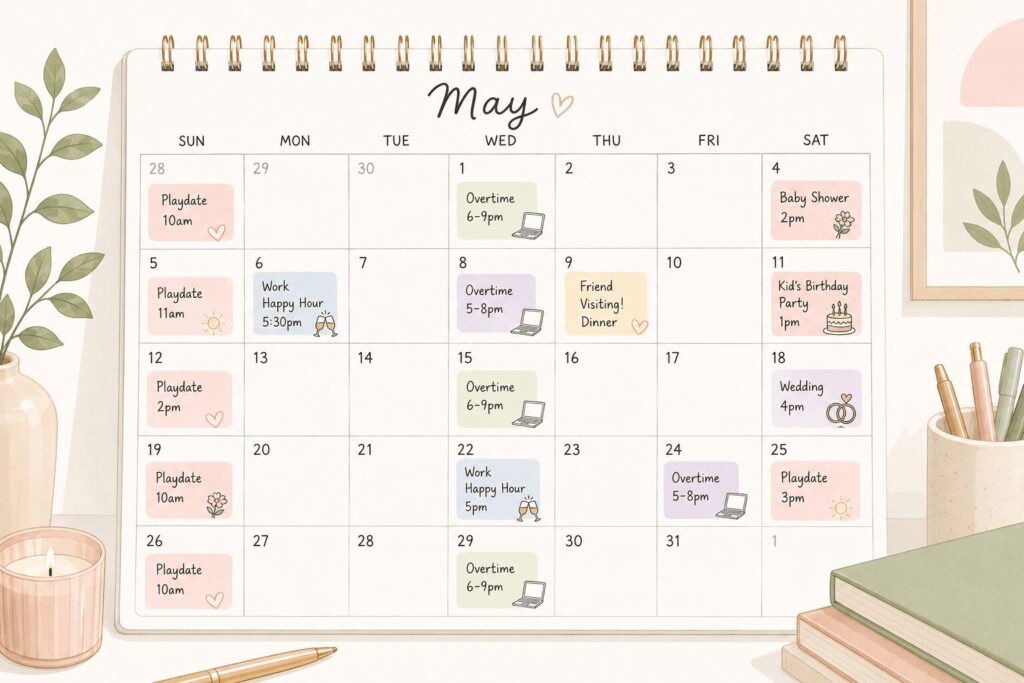
Meanwhile the kids’ birthday parties are multiplying in a way that feels genuinely supernatural. Your child’s friend invites them to a fun class or a gym playdate and you want them to go because they’re excited and childhood is short. The school has donation requests, fundraisers, spirit wear, events that weren’t even on anyone’s radar last year. And somehow all of it lands in the same month.
None of that is reckless spending. All of it is just being a person who loves people and is raising kids in a community. But the budget doesn’t know that. The budget just sees the number going up.
This is exactly why perfect budgets don’t work. They’re built for a predictable life, and most of us aren’t living one.
The Guilt Tax Nobody Talks About
When you’re budgeting solo, saying no is just a personal decision. When you’re budgeting as a family, saying no has an audience. You’re the one tracking the numbers, which means you’re also the one pumping the brakes on dinners, on activities, on things the kids are excited about, on experiences that actually matter to the people you love.
And after a while, always being the one who says we can’t, we’re over budget starts to feel terrible. So you give a little. And then a little more. And that’s when the slow slide begins, not dramatically, just quietly, category by category, until you look up and realize the budget has basically become decorative.
The Spiral You’ll Recognize
It goes like this.
You go $20 over in one category. Fine, it’s $20. Then it’s $50. Well, spread across the whole month that’s really not bad. Then you’re $200 over but honestly for the full year that’s like nothing. And then December arrives and you realize the budget kind of just stopped happening somewhere around April.
And that money you were going to save, the amount earmarked for investments, retirement, an actual financial goal, didn’t go to one big thing. It dissolved. Spread across a hundred small things that each felt completely reasonable in the moment. There’s nothing to point to. It just went.
That’s the part that’s demoralizing. Not the overspending itself, but the way it disappears without a trace.
The Hidden Cost of Convenience and Time
Here’s one that really snuck up on me, and honestly it’s a big reason why perfect budgets don’t work for busy families.
Before kids, if I was tired, not feeling well, or just completely done, dinner was whatever required the least effort. Ramen. Cereal. A sad little plate of crackers and cheese. Zero dollars spent and zero guilt about it.

Now I’m busy, running on empty, maybe not feeling well, AND I have to feed actual children an actual meal. So we order takeout. And that’s genuinely the right call in that moment, but it wasn’t in the budget because Past Me thought she’d just cook no matter what. Past Me had never met a Tuesday in October with three school pickups, a work deadline, and a kid with a mystery stomachache.
Or the school supply that lives in my head rent free for two weeks. I remember it at 10pm, I think I’ll get it tomorrow, I forget again, I remember it in the school pickup line, I forget again, and then I’m at the drugstore the night before it’s needed paying twice what it would have cost on Amazon if I’d just ordered it the first time I remembered. The mental load of keeping track of everything is real, and sometimes the cost of dropping one of those balls is a last minute convenience run.
Or the snacks. Buying the slightly more expensive ones because your kids will actually eat them is completely logical. Buying the giant Costco bag of their current beloved snack because it’s a great deal, and then watching it sit completely untouched until it expires because apparently that snack era is over — that one stings differently.
And don’t get me started on replacing things the youngest lost somewhere in the house. Not gone, definitely somewhere in the house, just completely unfindable when you need it. So you buy another one and find the original three weeks later in a shoe.
None of this is frivolous. It’s the real cost of a full life with kids, a partner, limited time, and a body that doesn’t always cooperate. But it almost never shows up in anyone’s budget template.
What Actually Works Instead
So I let go of perfect. And that’s when things actually started clicking.
What I do now is treat budget categories like guidelines, not hard walls. Each bucket has a number and I try to stay in range, but if one category runs over, it doesn’t mean we failed. What matters is whether our total spending for the month is under the overall number.
Dining went over because an out of town friend was visiting and of course we went out? Fine, as long as we didn’t also blow entertainment and clothing and three other categories in the same month. We look at the whole picture. We flex where we need to. We adjust and keep going.
This sounds looser than what I used to do. It’s actually more sustainable. Because I’m not abandoning the budget the moment one category slips. I’m not spiraling into well it’s already blown so who cares. I’m zooming out and asking the question that actually matters: are we spending less than we make and moving money toward things we care about?
That’s it. That’s the whole goal. Perfect budgets don’t work because life isn’t perfect, but a flexible one that you actually stick to? That works.

Give Yourself the Grace You’d Give a Friend
If your best friend told you she went over her grocery budget because her kid had a birthday party, she was running on three hours of sleep, she had a funeral to fly to, and she ordered takeout twice because she was exhausted, you would not tell her she failed at budgeting. You would say that sounds like a week, and hand her a coffee.
Be that friend to yourself.
Budgeting with a partner, with kids, with a real social life and a community you’re part of, it requires constant adjusting. The people who make it look perfectly controlled either have a lot of help, live very differently than they let on, or are still figuring it out too.
A budget you can actually live with, even imperfectly, beats a flawless budget you quietly abandon by April every single time.
So if your categories are a little messy but your overall number is holding, you’re doing it right. Keep going.
P.S. Check out more Sidekick’s Corner posts.