
401(k) Explained Simply: How It Works, Why It Matters, and How Much It Could Grow
If you’ve ever started a new job and completely zoned out during the benefits orientation, you’re not alone. Someone’s talking about enrollment windows and contribution percentages and your brain just… goes somewhere else. But here’s the thing: your 401(k) explained simply is actually not that complicated, and understanding it could be worth hundreds of thousands of dollars over your lifetime. No exaggeration.
Let me break it all down in a way that actually makes sense.
So What Even Is a 401(k)?
A 401(k) is a retirement savings account your employer offers you. You put in a chunk of your paycheck before taxes get taken out, it gets invested, and it grows over time until you’re ready to retire.
That’s it. That’s the basic idea.
The “before taxes” part is a big deal, by the way. It means you’re reducing your taxable income right now, today, while your money grows without being taxed along the way. You pay taxes when you pull it out in retirement, which is usually when your income is lower anyway.
And because it’s meant for retirement, you generally can’t touch it before age 59½ without paying a 10% penalty on top of regular income taxes. So think of it as your future self’s money.
A Quick Bit of History (Worth Knowing)
The 401(k) wasn’t always a thing. Back in the late 1970s, companies were struggling to keep up with traditional pension plans, which basically promised employees a set paycheck for life after retirement. Expensive and complicated to manage.
So the 401(k) came along as an alternative. Employees take more control of their own retirement savings, and employers can chip in through matching contributions without managing full pensions. That employer match is where it gets really interesting.
The Employer Match: Literally Free Money
Here’s the part that gets me every time I explain 401(k) explained simply to someone.
Most employers will match a percentage of what you contribute. A common setup is something like: your employer matches 50% of your contributions up to 6% of your salary.
Let’s put real numbers to it. Say you earn $52,000 a year, so about $2,000 per paycheck (bi-weekly).
- You contribute 6% = $120 from your paycheck
- Your employer adds 50% of that = $60
- Total going into your 401(k) that paycheck = $180
That’s $4,680 a year going into your account, and half of it didn’t even come from you.
If you’re not contributing at least enough to get your full employer match, you’re leaving free money on the table every single pay period.
How Much Can That Actually Grow?
This is where 401(k) explained simply gets really exciting.
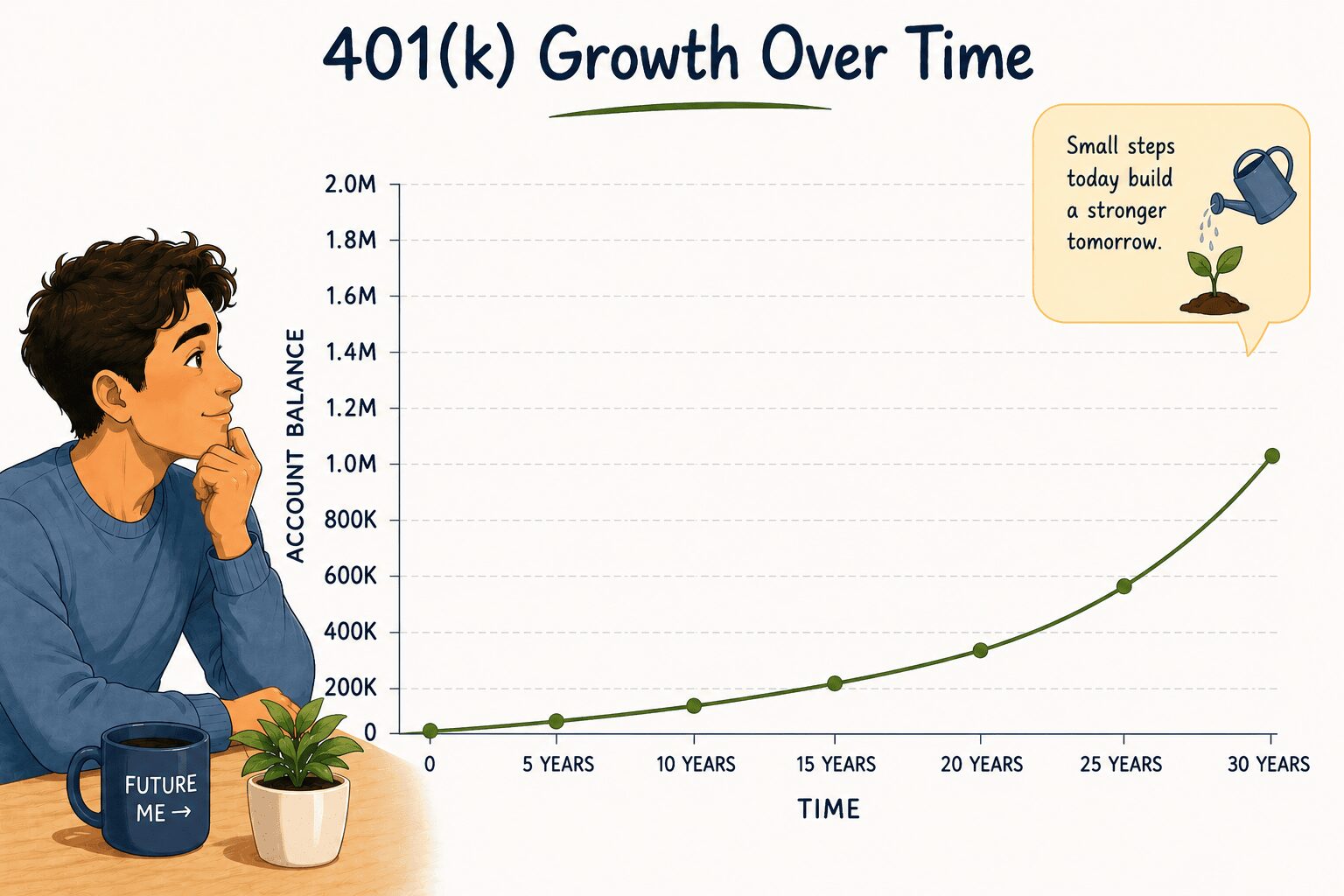
Here’s a quick snapshot of what consistent contributing can look like, assuming a $52K salary, 6% contribution, 50% employer match, a 1% annual raise, and 7% average annual investment returns:
| Year | Total You Contributed | With Employer Match + Growth |
| 10 | ~$31,200 | ~$64,660 |
| 30 | ~$93,600 | ~$442,076 |
You put in $93,600 over 30 years. Your account grows to over $442,000.
That’s the power of compound growth. Your money earns returns. Then those returns earn returns. It just keeps building on itself, and time is the secret ingredient.
The Story That Made Me Want to Talk About This
My dad told me about my 401(k) when I started my first real job. Sign up, contribute at least enough to get the match, don’t think twice. So I did. Right away.
But someone I know? She figured she’d look into it later. Later turned into months. Months turned into years. And before she knew it, five years had gone by. Five years of no contributions. No employer match. No compound growth. Just… nothing happening in that account.
When she finally sat down and looked at what she’d missed out on, it stung.
I’m not sharing that to make anyone feel bad. I’m sharing it because 401(k) explained simply is exactly the kind of thing that should be talked about more, so no one else loses five years without realizing it.
How Much Can You Actually Contribute?
In 2026, the IRS lets you contribute up to $23,500 to your 401(k) if you’re under 50. If you’re 50 or older, you can add catch-up contributions on top of that.
You do not have to max it out to make serious progress. Even just contributing enough to capture your full employer match is a great starting point.
I started out just contributing enough for the full match. Over time I bumped it up, and now I’m focused on maxing out retirement accounts across the board for the tax advantages. (We’ll dig into that whole strategy in another post, but the short version is: every dollar in a tax-advantaged account is working harder for you than a dollar sitting in a regular brokerage account.)
Pro tip: Every time you get a raise, try bumping your contribution percentage by 1%. You likely won’t feel it in your take-home pay, but Future You absolutely will.
Wait, Don’t Forget to Actually Invest It
This trips people up more than you’d think.
Putting money into your 401(k) is step one. Actually investing that money is step two. And step two matters just as much.
If you enroll and never choose your investments, your contributions could sit in a low-interest cash fund earning almost nothing. Inflation quietly eats away at it. That’s not what we’re going for.
What to look for: the expense ratio.
Every fund charges a fee called an expense ratio. It’s a small percentage taken out each year to cover management costs. This might sound tiny, but over decades it adds up to a lot of money leaving your account.
Keep your expense ratio under 0.5%. Ideally, way under. Many index funds charge as little as 0.03% to 0.10%. That’s basically nothing.
Actively managed funds often charge 1% or more, and here’s the kicker: they rarely outperform the simple index funds that cost almost nothing. Even Warren Buffett proved this. In 2007, he bet $1 million that a simple S&P 500 index fund would outperform a hand-picked selection of hedge funds over a decade. By the end, the Vanguard S&P 500 index fund he chose returned 125.8%, while the hedge funds ranged from just 2.8% to 87.7%. The difference? Fees. The Vanguard fund had an expense ratio of just 0.04%, meaning almost all of the growth stayed with the investor. Yahoo Finance + 2
The lesson: you don’t need someone actively managing your money and charging you for it. A simple, low-cost index fund does the job, and then some.
So what should you actually pick?
Look for an S&P 500 index fund or a total market index fund. If your plan offers Fidelity or Vanguard options, those are solid. You want something simple, broad, and cheap.
What to avoid: anything with a high expense ratio, actively managed funds that promise to “beat the market,” and putting too much into your company’s own stock (don’t put all your eggs in one basket).
Can You Take Money Out Early?
Technically yes. But you really don’t want to.
Early withdrawals before age 59½ come with a 10% penalty plus regular income taxes on the amount you pull out. It adds up fast and can seriously set back your progress.
There are some exceptions:
- Hardship withdrawals if your plan allows it
- Rule of 55: If you leave your job at 55 or older, you can withdraw without the penalty (taxes still apply)
- 401(k) loan: Some plans let you borrow from yourself and pay it back with interest, but there are risks if you leave your job before it’s paid off
The bottom line: treat it like it’s off limits unless it’s a true emergency.
Before You Go: Quick Wins to Start Strong
- Contribute at least enough to get your full employer match. Every time.
- Increase your contribution by 1% every time you get a raise.
- Actually choose your investments. Don’t let your money sit in cash.
- Check the expense ratio on any fund you pick. Under 0.5% is the goal, and lower is always better.
- Stick to simple, low-cost index funds. An S&P 500 or total market fund is a great place to start.
- Keep tabs on any old 401(k)s from previous jobs. You can roll them over into an IRA or your current employer’s plan so that money stays working for you, not sitting forgotten somewhere.
- Don’t withdraw early. The penalties are real and the lost growth is even more painful.
Your 401(k) explained simply comes down to this: it’s a tax-advantaged retirement account that grows your money through investing, gets boosted by your employer’s match, and rewards you most when you start early and stay consistent.
You don’t need to be a finance person to do this well. Pick a low-cost index fund, keep fees low, and let time do the heavy lifting.
Future You is counting on it.
P.S. If you want to keep making the most of what your employer is already offering, check out How to Maximize Employee Benefits And if you want to go deeper on other tax-advantaged accounts, 401(k) Explained Simply: How It Works, Why It Matters, and How Much It Could Grow and ESPP Explained Simply: Why You Shouldn’t Miss Out and HSA Account Explained Simply: Why It’s One of the Best Tools for Healthcare and Retirement are great next reads.



5 Comments