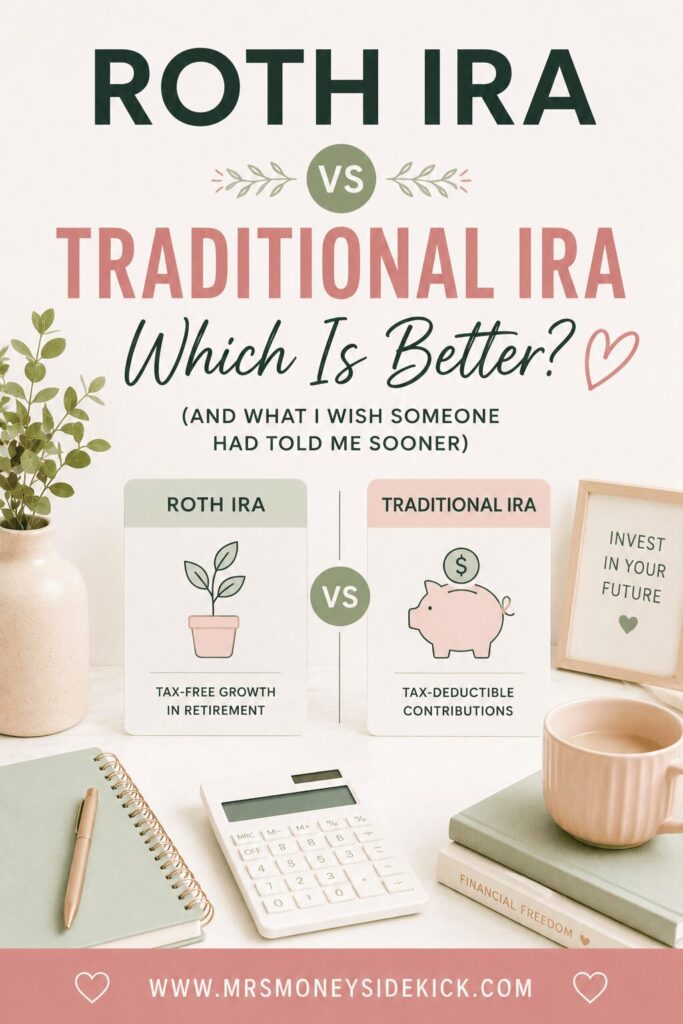
Roth IRA vs Traditional IRA Which Is Better (And What I Wish Someone Had Told Me Sooner)
My dad gave me solid financial advice when I was starting out. He told me to open a traditional IRA because of the tax deduction I’d get when filing. It made sense. I trusted him. He was trying to help. The problem? Neither of us fully understood what we were actually choosing, and figuring out the answer to Roth IRA vs traditional IRA which is better ended up costing me more than I expected. Literally.
Here’s what I learned the hard way, so you don’t have to.
First, Let’s Talk About What These Accounts Actually Are
Both a Roth IRA and a traditional IRA are individual retirement accounts that let your money grow over time. The big difference is when you pay taxes on that money.
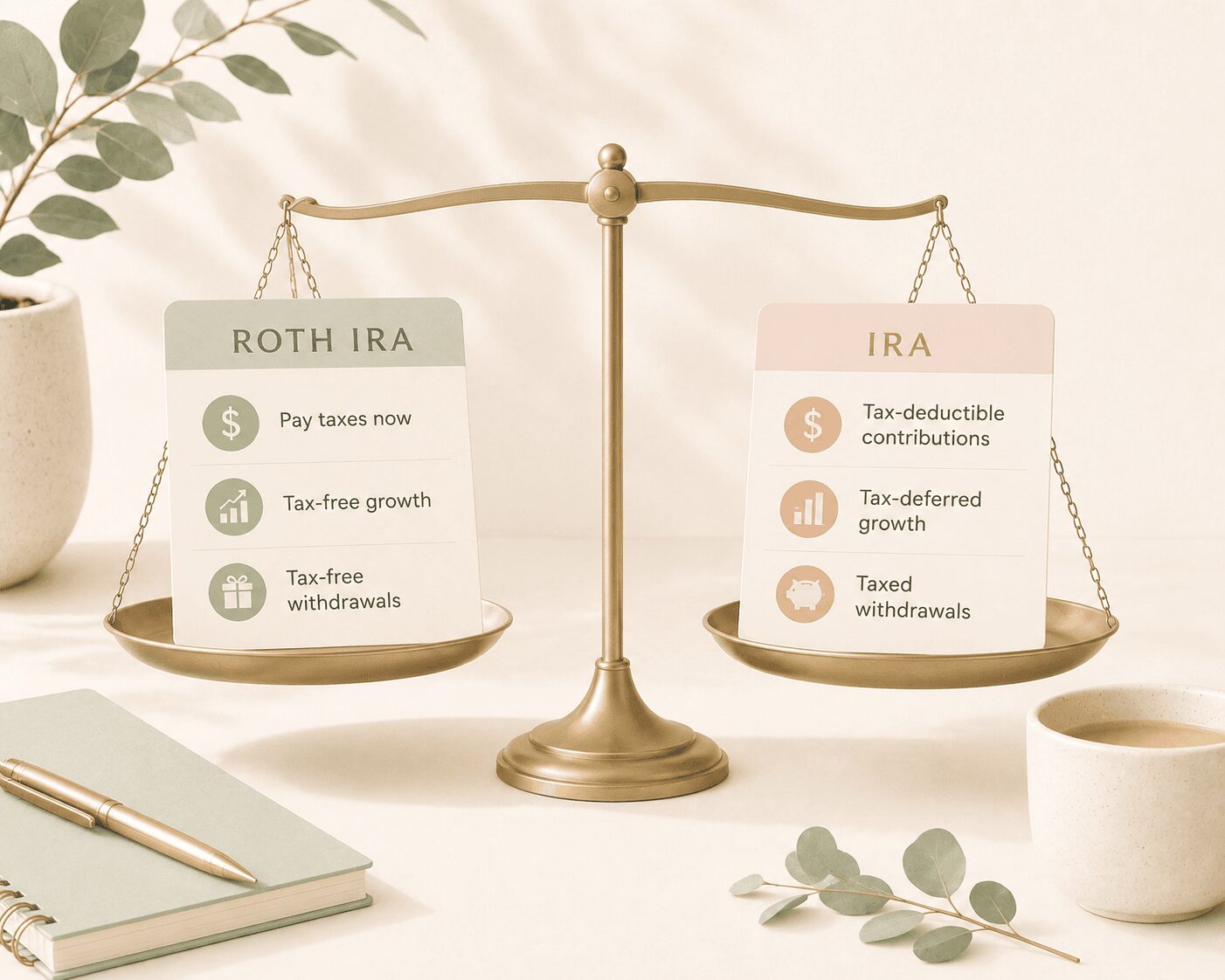
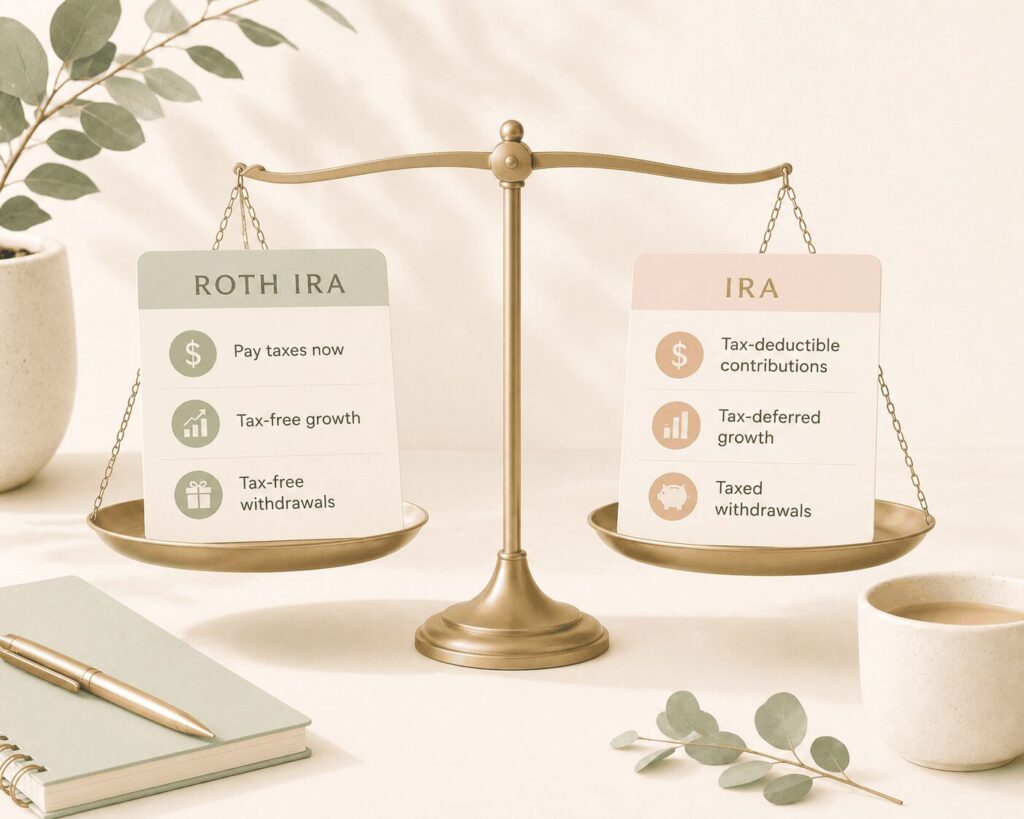
Traditional IRA: You contribute pre-tax dollars (which can lower your taxable income now), your money grows tax-deferred, and then you pay taxes when you withdraw in retirement.
Roth IRA: You contribute money you’ve already paid taxes on, your money grows tax-free, and qualified withdrawals in retirement are completely tax-free.
That one difference changes everything about how these accounts work long-term. And when it comes to Roth IRA vs traditional IRA which is better, understanding that timing is where it all starts.
Why My Dad’s Advice Wasn’t Wrong, Just Incomplete
The traditional IRA tax deduction is real and it’s appealing. If you contribute $6,500 to a traditional IRA, you might be able to deduct that from your taxable income. When you’re watching every dollar, that upfront break feels like a win.
But here’s what neither of us thought about: when I was starting out, I was in a lower tax bracket. That’s actually the best time to choose the Roth IRA, because you’re paying taxes on your contributions now, while your rate is lower, and then everything that grows over the next 20 or 30 years comes out completely tax-free.
When Roth IRA vs traditional IRA which is better comes up, tax bracket timing is everything. If you’re early in your career or not at peak earnings yet, Roth usually wins.
The Other Thing Nobody Told Me About Traditional IRAs: RMDs

RMDs stand for Required Minimum Distributions. Once you hit a certain age (currently 73), the IRS requires you to start pulling money out of your traditional IRA and 401k, whether you need it or not. And you’ll owe taxes on every dollar you pull out.
Roth IRAs have no RMDs. Zero. If you don’t need the money at 73, you don’t have to touch it. You can let it keep growing, use it strategically, or pass it on to your kids.
Speaking of which: the Roth IRA is one of the cleanest wealth transfer tools out there. Your heirs inherit those funds and, depending on the rules at the time, can continue to benefit from that tax-free growth. With a traditional IRA, every dollar they inherit comes with a tax bill attached. That’s worth thinking about if building something for the next generation is part of your bigger picture.
That flexibility is huge, and it’s one of the reasons Roth IRA vs traditional IRA which is better often tilts toward Roth for people who want more control now and later.
The Accidental Backdoor Roth (My Expensive Oops Moment)
Here’s where my story gets a little humbling.
Years after opening my traditional IRA, I decided I wanted to start contributing to a Roth IRA instead. Made sense, right? I knew I wanted that tax-free growth going forward.
So I went to make a contribution. And somehow, on autopilot, I contributed to my traditional IRA again instead of the Roth. Not a big deal, I thought. I’ll just move it over.
What I didn’t realize was that moving money from a traditional IRA to a Roth IRA is called a Roth conversion, and it’s a taxable event. The amount you convert gets added to your taxable income for that year. I had accidentally stumbled into what’s known as a backdoor Roth conversion, a strategy that can actually be intentional and useful, but in my case was just a surprise tax bill I was not prepared for.
So yes, learn from me: moving money from a traditional IRA to a Roth isn’t free.
What Is a Backdoor Roth Conversion, and When Does It Actually Make Sense?
A backdoor Roth is a strategy some people use intentionally when they earn too much to contribute directly to a Roth IRA (there are income limits). The idea is you contribute to a traditional IRA and then convert it to a Roth.
But here’s the catch most people miss, including me: if you already have existing traditional IRA money sitting around, the IRS applies something called the pro-rata rule. That means you can’t just convert the new contribution cleanly. The IRS looks at ALL your traditional IRA money combined and taxes the conversion proportionally.
So if you’re thinking about doing a Roth conversion or a backdoor Roth intentionally, you need to know going in whether you have existing traditional IRA funds, because that changes the tax math significantly.

When thinking through Roth IRA vs traditional IRA which is better, this is one of those details that can quietly cost you if you don’t know about it.
The Bigger Picture: Don’t Keep All Your Retirement in One Tax Bucket
This is the part I think gets overlooked in the basic “which account should I open” conversation.
The real goal in retirement isn’t just having enough money. It’s having flexibility in how you access it. If all your retirement savings are in tax-deferred accounts like a 401k and traditional IRA, every dollar you pull out in retirement is taxable income. That can push you into a higher tax bracket, affect what you pay for Medicare, and create a tax headache you weren’t expecting.
Having a mix of account types gives you options:
Tax-deferred accounts (traditional IRA, 401k): You get the tax break now, pay taxes later. Good for high-earning years.
Tax-free accounts (Roth IRA): You pay taxes now, everything grows and comes out tax-free. Great for lower-earning years or when you want flexibility later.
Taxable brokerage accounts: No special tax advantages, but also no contribution limits or withdrawal restrictions. A solid third bucket for money you might need before retirement age or want to access more freely.
The answer to Roth IRA vs traditional IRA which is better isn’t always just one or the other. Having a mix over time gives you more control over your tax situation when you actually need the money.
Retirement Isn’t a Paycheck. It’s a Strategy.
Here’s something most people don’t realize until they’re actually in retirement: there’s no automatic paycheck coming. You have to decide where to pull your money from, in what order, and in what amounts. And those decisions have real consequences that follow you for decades.

This is not like your W-2 job where taxes are handled before the money hits your account. In retirement, you are managing your own income. The order in which you tap your accounts can affect:
- What you leave behind for your kids and whether they inherit a tax bill along with it
- How much federal and state income tax you owe each year
- Whether you trigger higher Medicare premiums (yes, your income level affects what you pay for Medicare)
- How much of your Social Security benefits get taxed
- Whether RMDs unexpectedly push you into a higher bracket
- Your eligibility for certain credits or benefits tied to income thresholds
Pull too much from a tax-deferred account one year and suddenly you’re in a higher bracket. Pull strategically from your Roth instead and that same amount could be completely tax-free. This is why having multiple account types isn’t just a nice-to-have. It’s a long-term tax planning tool.
We’ll go much deeper on retirement income strategy in a future post, because it genuinely deserves its own conversation. But the point here is: the accounts you build now determine the options you have later. That’s why Roth IRA vs traditional IRA which is better is a question worth getting right as early as possible.
So, Roth IRA vs Traditional IRA Which Is Better?
Here’s a simple way to think about it:
Lean toward Roth IRA if:
- You’re early in your career or in a lower tax bracket right now
- You want tax-free growth and withdrawals
- You don’t want to deal with RMDs later
- You want to pass on tax-free money to your heirs
- You want flexibility in how you manage income in retirement
Lean toward Traditional IRA if:
You’re maximizing other accounts first and this is additional savings
You’re in a high tax bracket now and expect to be in a lower one in retirement
You want the tax deduction this year
And honestly, if you can swing it, contributing to both over time while also building up a taxable brokerage account gives you the most flexibility of all. That’s the real answer to Roth IRA vs traditional IRA which is better: it’s not a competition. It’s a combination.
The Takeaway
I followed advice that wasn’t bad. It just wasn’t complete. Nobody sat me down and explained that Roth IRA vs traditional IRA which is better depends on your tax bracket right now, your tax bracket later, how much control you want in retirement, and whether you’re thinking about what you leave behind.
The accidental conversion was an expensive lesson, but it pushed me to actually understand these accounts instead of just checking a box.
If you’re earlier in this decision than I was, you have time to make it with full information. Open a Roth if you’re in a lower bracket. Keep tax diversification in mind as you build. And if you already have a traditional IRA and are thinking about converting, talk to a tax professional before you move anything, because unlike me, you can make that decision on purpose.
The accounts you build today are the options you get in retirement. Make them count.
Have questions about which IRA makes sense for your situation? Drop them in the comments.
P.S. Check out our other Retirement posts!