
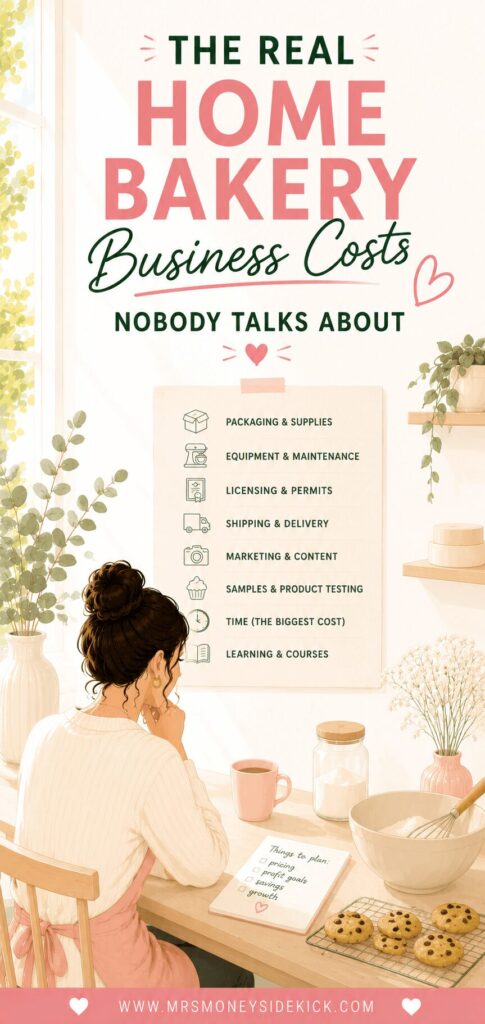
The Real Home Bakery Business Costs Nobody Talks About
You’ve been baking for years. People lose their minds over your macarons at every get-together. Someone finally says “you should sell these!” and just like that, your brain starts running the numbers. A box here, a custom order there… this could actually work.
And it can. But before you post your first order form, there are some very real home bakery business costs that most people find out about the hard way, after they’ve already started selling. I’ve been through the setup myself, made decisions along the way, and I want to share what I know so you don’t have to figure it out from scratch.
One thing before we dive in: I’m using Los Angeles as an example throughout this post. Fees, permits, and requirements vary by city and county, so always verify with your local agencies. The overall structure though? Pretty universal.
First, the Elephant in the Room: Many Home Bakers Are Unlicensed
Let’s be honest. A significant number of home bakeries operate without any licenses or permits. No cottage food registration, no city business license, no insurance, nothing.
That’s a real savings, we’re talking hundreds to potentially thousands of dollars a year.
But it comes with serious risk. If a customer gets sick, traces it back to your kitchen, or decides to make it your problem for any reason, you have no legal protection. And if your HOA prohibits running a business from your home, which some do, operating unlicensed makes that exposure even worse. Some people do it anyway. That’s a personal decision, but it’s worth knowing exactly what you’re betting.
Step One Before Anything Else: Decide Your Business Structure
Here’s something I wish someone had told me upfront. Before you file for any license, permit, or business name, you need to decide whether you’re operating as a sole proprietor or an LLC (Limited Liability Company). That decision affects everything: your business name filing, what name goes on your permits, how you handle taxes, and how much protection you have if something goes wrong.
Sole Proprietor: Simple but Exposed
As a sole proprietor, there’s no separate legal filing. Your business is just you. Income from the bakery gets reported on your personal tax return using Schedule C, where you list your income, deduct your business expenses, and pay self-employment tax on whatever’s left.
It’s the simplest and cheapest way to start, and honestly, it’s where most of us begin. I did too.
The downside is that your personal assets, your home, your savings, everything, are on the line if someone sues your bakery. There’s no legal wall between you and the business.
LLC: Protection with a Price Tag (Especially in California)
An LLC creates what’s called a corporate veil, a legal separation between you and the business. If a customer sues your bakery, your personal assets have some protection.
Since it’s probably just you with no employees, the LLC is a pass-through entity for tax purposes. The business income still flows to your personal return, and you still file Schedule C. But in California, you’ll also need to file Form 568 (the LLC Return of Income) every year, which adds some extra paperwork on top of the usual.
What it costs in California: a $70 filing fee with the Secretary of State, an $800 annual franchise tax every single year regardless of revenue, and a $20 Statement of Information every two years. In year one, you’re looking at at least $890 just to exist as an LLC. Every year after that, $800 minimum.

I started as a sole proprietor and eventually made the move to an LLC. Not because something bad happened, but because I wanted to protect my family. We had worked hard to build something, and I didn’t want the bakery to ever be a risk to our assets if things went sideways. I already had umbrella insurance, but the LLC felt like an intentional extra layer on top of that. Once I thought about it that way, it was an easy decision.
One critical thing if you do form an LLC: keep your business finances completely separate from your personal ones. Not just for bookkeeping reasons, but because commingling personal and business funds can actually pierce that corporate veil yourself. If you mix everything together, a court could decide the LLC isn’t really a separate entity, and your personal assets lose that protection. Separate bank account, separate credit card, from day one. No exceptions.
A Note on Address Privacy
If you form an LLC, your home address gets listed in California’s public business database. If you want to keep your home address private, you can use a virtual mailbox service, a real street address (not a PO box, which California does not accept for LLC registration) for around $20 to $30 per month.
The Setup Order: What to Do and When
Here’s the sequence that makes the most sense so you’re not redoing paperwork with the wrong name or structure on it:
- Decide: sole proprietor or LLC — this sets everything else
- Form your LLC with the CA Secretary of State if going that route, or skip this for sole prop
- File your FBN (Fictitious Business Name) if needed — more on this below
- Get your EIN from the IRS, free and quick, and you’ll need it before opening business accounts
- Open a separate business bank account and credit card
- Register for your Cottage Food Operation permit with your county health department
- Complete your food safety training (required within 3 months of registration)
- Get your Seller’s Permit from the CDTFA, free, and it lets you buy ingredients and packaging tax-free
- Apply for your city business license
- Get business insurance and review your umbrella policy
Home Bakery Business Costs: The FBN and Business Name
Whether you need a Fictitious Business Name (FBN) depends on your structure and what you want your bakery to be called.
If you form an LLC, your legal business name already includes “LLC” at the end. You do not need an FBN unless you want to drop the “LLC” from the name you use publicly. For example, if your LLC is registered as “Sweet Layers LLC” but you want to operate simply as “Sweet Layers,” you’d file an FBN to use that name. Confirm this with your county clerk for your specific situation.
If you’re a sole proprietor and your bakery name is anything other than your full legal name, you need an FBN.
In Los Angeles County, the filing fee is $26, plus about $10.75 if you file online. California also requires you to publish a notice in a local newspaper for four consecutive weeks, then submit proof of publication back to the county. That publication can run anywhere from $29 to $50 at smaller local papers, up to $85 to $189 at larger ones. Shop around because the cheaper papers are completely valid. All in, budget $65 to $225 for the FBN depending on which paper you use.
Home Bakery Business Costs: The Cottage Food Permit
In California, selling baked goods from your home means registering as a Cottage Food Operation (CFO) with your local county health department.
Class A is for direct sales only: selling from your home, through your website, at farmers markets, or at pop-ups. In Los Angeles County, the Class A registration runs around $100 to $175, and your product labels need to be reviewed and approved. Additional label reviews after your initial application can cost $167 per hour per LA County’s fee schedule.
Class A comes with a gross revenue cap. California’s 2025 limit is $86,206, adjusted for inflation each year. That’s gross, before expenses. So your actual take-home after ingredients, packaging, fees, and insurance is meaningfully less than that ceiling.
Class B allows indirect sales too, meaning you can also sell to stores, restaurants, and cafes. In LA County, the Class B permit is $292 and requires a home kitchen inspection. The Class B revenue cap is currently $172,411.

For most home bakers selling directly to customers, Class A is where you start.
You’ll also need to complete a food safety training course within three months of registering. Online ANAB-accredited courses run about $10 to $30 and take a couple of hours.
And one more thing: California restricts which products you can sell under cottage food law. Only shelf-stable, non-refrigerated foods make the approved list. Cream fillings, custards, and anything that needs refrigeration are out. Know your approved food list before you finalize your menu.
Home Bakery Business Costs: City Business License
Separate from your cottage food permit, most cities require a business license to operate any business in their jurisdiction, not just food businesses. It’s a “you’re running a business in our city” requirement across the board.
In the City of Los Angeles, a new business license runs around $200 and renews annually.
Home Bakery Business Costs: The EIN
Get your EIN (Employer Identification Number) from the IRS. It’s free, takes about 10 minutes online, and means you’re not handing out your Social Security number to every vendor, marketplace, or customer who needs your tax info. Do this one right away.
Home Bakery Business Costs: Insurance

Bakery-Specific Business Insurance
A home bakery liability insurance policy runs about $300 per year. It covers things like a customer claiming they got sick from your product, an allergic reaction, or an issue with an order. If you’re selling food to people, this is your baseline.
Umbrella Insurance
If you have assets worth protecting, umbrella insurance deserves a serious look. A $1 million personal umbrella policy typically costs $150 to $380 per year and kicks in when your other insurance limits run out.
I had umbrella insurance before I even thought about the LLC, and it’s what gave me enough comfort to start out as a sole proprietor. But eventually I wanted the LLC as an additional layer, not because I expected something to go wrong, just because I wanted to be intentional about protecting what we’d built. Umbrella coverage plus an LLC felt like the right combination for where we are.
Your HOA
Check your HOA rules before you invest in any of this. Some HOAs prohibit running a business from your home. Some bakers do it anyway and take that risk. Just know what the rules are before you start.
Home Bakery Business Costs: Website, Domain, and Payment Processing
Domain Name
Your domain name is a separate cost from your website itself, and it’s easy to forget to budget for it. A standard .com domain runs $10 to $20 per year at most registrars. Watch out for first-year promotional prices that jump at renewal. Budget around $12 to $15 per year as a realistic ongoing cost.
A good domain name is worth it. You want something easy to remember and easy to type. That’s not vanity, that’s just good business.
Website
There are free website options out there, and if you’re just starting out, they might be enough to get going. Fair warning though: free plans tend to be very limited in how they look and what you can do with them, and that matters when you’re selling a product where presentation counts.
I found a paid platform that was only $10 a month, which felt worth it at the time. Then they changed their pricing model and the value just wasn’t there anymore, so I moved to Square. Switching platforms means rebuilding your entire site: redoing your menu, relinking everything, updating photos, starting over on what took you hours to set up the first time. That time is a cost even when money isn’t.
I’m on Square’s Plus plan now at $29 a month (around $300 a year) because I wanted to connect my custom domain directly to the site. You might be able to get by with their free plan, and there may be workarounds for the domain connection, but figuring out those workarounds takes time and some technical know-how. I decided my time was better spent elsewhere. Your call on what makes sense for you.
Some home bakers eventually run into limitations with Square too and move to another platform. It happens. Every switch costs you time.
Payment Processing
I take all orders online with full payment upfront. Before I start anything, the order is paid. For people I personally know, sometimes cash works when I see them. But for everyone else, online payment comes first.
I’ve never had a no-show in all my years doing this, but I’m not going to create the conditions for it to happen. And honestly? Most customers who respect your work don’t push back on paying upfront. They just pay.
Square’s current rate is 2.6% plus $0.15 per in-person transaction and 3.3% plus $0.30 for online payments. On a $60 order that’s about $2.28 in fees. It adds up across every order, and that’s just the reality of using any payment platform.

Home Bakery Business Costs: Sales Tax and Your Seller’s Permit
In California, most baked goods sold for home consumption are exempt from sales tax, but not all categories are. Depending on what you sell and how, you may need to collect and remit sales tax to the state.
Get a Seller’s Permit from the CDTFA either way. It’s free. The benefit is that it allows you to purchase ingredients and packaging supplies without paying sales tax on them, since those materials go into the product you’re reselling. That’s a real savings over time, especially once your supply purchases are consistent.
If you do collect sales tax, track it carefully throughout the year and file your returns on time.
Home Bakery Business Costs: Packaging and Supplies
This one surprises people even when they’re keeping things simple.
I keep my setup practical: white boxes, no seasonal themes, colored ribbons for certain orders but not always tied because tying ribbons is extra time and cost. I use larger boxes (pie boxes, cake boxes) for my macaron orders since my minimum is two dozen and smaller macaron-specific boxes just don’t fit that quantity. There are smaller boxes on hand for preorders when the quantity is lower.
Even keeping it simple, you’re still buying across a few categories:
Packaging: boxes in multiple sizes, food-grade parchment or tissue paper to line them, stickers or labels for your branding, ribbon for some orders, cookie backers if you do cookies.
Behind-the-scenes supplies: air-tight storage containers for keeping finished product fresh before pickup, piping bags, tips, couplers, extracts, gel food coloring, sprinkles in more colors than you’d expect, saranwrap, zip-lock bags, and paper towels. You will go through paper towels at a rate that seems impossible until you’ve cleaned up buttercream for the fifth time in one afternoon.
I buy in bulk and don’t restock every single month, which helps. But the first time you stock up it adds up fast. Realistically, an initial supply run can run $150 to $300, and ongoing restocking throughout the year is a steady expense that rarely makes it into anyone’s product pricing.
Home Bakery Business Costs: The Time You’re Not Counting
This is the part that doesn’t appear on any fee schedule, but it’s probably your biggest real cost.
Your Actual Labor
I make macarons. I’m good at them. It might take me a fraction of the time it would take someone still learning, but that expertise doesn’t always find its way into the price.
If someone is selling custom character macarons for $3.50 each while the going rate for standard circle macarons is $3.00, they’re charging barely anything more for custom work that most people cannot do at all. Custom character macarons require skill that a basic circle doesn’t, and the pricing should reflect that gap.
Now here’s the harder truth about custom work specifically: some customers absolutely will pay what your work is worth. But realistically, there’s still a ceiling. You can’t undersell yourself, but you also can’t price yourself out of the market. It’s a balance, and sometimes that balance doesn’t fully account for everything you bring to the table. Especially for highly skilled, time-intensive work that looks effortless because you’re that good at it.
I batch everything and keep a minimum of two dozen per order. A batch usually makes closer to 30, so I have extras to account for breakage, color inconsistencies, or shells that just don’t cooperate. I always include an extra for the customer too. But if the order was custom, those extras usually aren’t sellable, so they get absorbed.
And sometimes I redo an order entirely. Overmixed shells, a color that doesn’t match the reference photo, a batch that just didn’t come together. I eat that cost because I care about the work. But it’s still a cost.
The Hours Nobody Counts

There’s an entire second job running alongside the baking:
Answering DMs and emails about orders. Going back and forth on custom design requests, sometimes long conversations with customers who then place no order. Scheduling ingredient pickups. Researching color theory to figure out how to hit that exact shade of dusty rose the customer sent in a screenshot. Counting and managing inventory. Photographing finished orders for social media. Planning your content calendar. Printing and applying labels. Packaging finished orders.
And then there’s pickup. Some bakers leave orders on the front porch. Some do home pickups. Some meet at a public spot. However you do it, there’s time involved, and some customers are on time, some are late, and some are very late. You’re just there, waiting, when you could be doing something else.
None of these hours get priced into anything. But if you hired someone else to do any of it, you’d pay them.
And don’t forget the annual tax filing. Tracking income and expenses throughout the year, keeping receipts organized, making sure personal and business finances never touch, filing on time. That’s ongoing work too.
A Word on Markets, With the Actual Math
Markets can be a great way to get your product in front of new people, and plenty of bakers build loyal repeat customers from them. But there’s a hidden labor cost that most people don’t think about before their first one, and it’s worth running the numbers before you commit.
The prep alone takes real time. Baking for an unknown quantity, packing everything up, loading the car. Then there’s the 6 hours of actually manning the booth. That’s labor, and if someone else were standing there selling for you, you’d pay them for every single one of those hours. When it’s you, that time disappears from the equation.
So let’s do the math. Say you sell macarons at $3 each and the booth fee for a 6-hour market is around $80, which is on the lower end. Markets in high-traffic urban areas can run $100 or more.
To just cover that booth fee, you need to sell about 27 macarons. But you also have ingredients, packaging, and gas on top of that. And if you add even minimum wage for 10 hours of total time between prep and the market itself, that’s another $165 you need to cover before you’ve made anything real.
You need to move serious volume at $3 a macaron just to break even, and that’s before accounting for leftovers you can’t sell because they were prepped specifically for that day.
The other thing nobody warns you about: you can’t always predict how much to make. Too little and you sell out early. Too much and you’re selling cheaper to move product, giving things away, or hoping the next market is close enough to freeze for. The uncertainty is its own kind of stress.
A helpful reframe: markets are as much advertising as they are income. You’re getting your product in front of people who didn’t know you existed. Someone tries a sample, loves it, and now they know where to find you for their next custom order. That long-term visibility has real value. If you go in expecting to build awareness and maybe break even, markets can absolutely make sense. If you go in expecting to profit significantly that day, the math is a tough one to crack, especially early on.
The Real Cost Breakdown
Here’s a summary of home bakery business costs for a Class A CFO using Los Angeles as the example. Verify your own local fees before budgeting:
| Cost | Estimated Amount | Type |
| Sole proprietor setup | $0 | One-time |
| LLC filing fee (CA Secretary of State) | $70 | One-time |
| LLC annual franchise tax | $800 | Annual renewal |
| LLC Statement of Information | $20 | Every 2 years |
| FBN filing (LA County) | ~$26 | One-time (renews every 5 years) |
| FBN newspaper publication | $29 to $189 | One-time |
| EIN from IRS | Free | One-time |
| CFO Class A registration (LA County) | $100 to $175 | Annual renewal |
| Food safety training | $10 to $30 | Every 3 years |
| City business license (City of LA) | ~$200 | Annual renewal |
| Seller’s Permit (CDTFA) | Free | One-time |
| Bakery business insurance | ~$300 | Annual renewal |
| Umbrella insurance ($1M coverage) | $150 to $380 | Annual renewal |
| Domain name | ~$12 to $15 | Annual renewal |
| Website platform (Square Plus) | ~$300 | Annual renewal |
| Initial packaging and supply run | $150 to $300 | One-time, then ongoing |
| Virtual mailbox (if privacy needed) | ~$240 to $360 | Annual renewal |
For a legitimate, insured, licensed sole proprietor the startup picture is roughly $1,200 to $1,800 before you sell a single thing. The LLC adds the $800 annual franchise tax every year on top of that.
The Bottom Line on Home Bakery Business Costs
None of this is meant to scare you off. A home bakery can be a real and meaningful income stream. But it’s a business, and it deserves to be treated like one.
The bakers who make it work are the ones who go in knowing the actual numbers: the licenses, the fees, the packaging, the taxes, and the honest cost of their own time and skill. You cannot price yourself correctly if you’re guessing or leaving half the costs out of the equation.
And the labor piece? That one’s ongoing for all of us. Custom work has a ceiling, the market has opinions, and sometimes the math doesn’t fully close even when you do everything right. But knowing that going in is still better than being surprised by it later.
Price like someone who knows what she’s doing. Because you do.
P.S. Check out other Home Bakery post!




One Comment